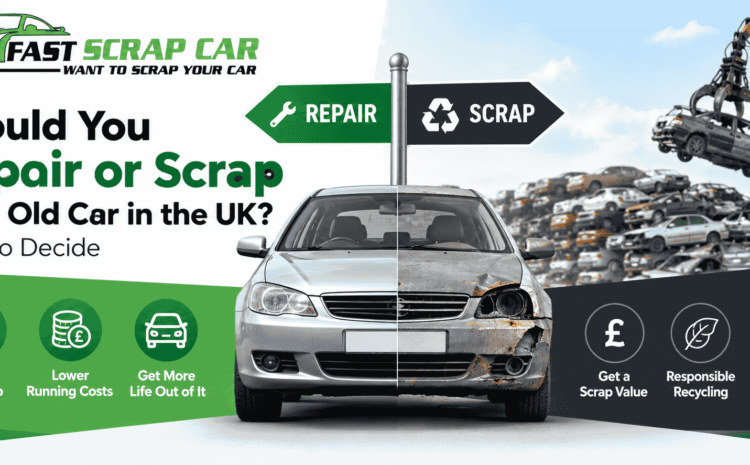
Should You Repair or Scrap Your Old Car in the UK? How to Decide
Owning an older car can be convenient, but keeping it on the road may become expensive as it ages. Frequent breakdowns, rising repair bills and MOT failures can leave you wondering whether to invest more money or consider scrapping your vehicle.
The right decision depends on your car’s condition, its current value, the cost of necessary repairs and how reliably you need it to run. In some cases, a relatively small repair can extend your car’s life. In others, scrapping it may be the more sensible financial choice.
In this guide, Fast Scrap Car explains how to compare your options and decide what to do with an old or unwanted vehicle.
1. Calculate the Cost of Repairs
Before making a decision, ask a trusted mechanic to inspect your car and provide a breakdown of the recommended repairs. This will help you understand whether the work is essential, optional or likely to lead to further expenses.
Consider the following costs:
- Engine repairs: Major engine problems can be expensive, particularly if several components need replacing.
- Gearbox problems: Transmission repairs may cost a significant amount, depending on the fault and vehicle model.
- MOT failures: Some faults are inexpensive to fix, while others require extensive mechanical or structural work.
- Rust and corrosion: Serious corrosion affecting important structural areas can make repairs uneconomical.
- Brakes, tyres and suspension: These parts may need attention as a vehicle ages, adding to your maintenance costs.
Compare the total repair estimate with your car’s current market value and the likely cost of maintaining it over the next year. If the necessary work costs more than the vehicle is realistically worth, scrapping it may be worth considering.
However, an expensive repair does not automatically mean you should scrap the car. A dependable vehicle may still be worth repairing if it would otherwise be costly to replace.
2. Check Your Car’s Current Market Value
Your car’s age alone does not determine its value. Make, model, mileage, service history, condition and demand can all influence what a buyer might pay.
Research similar vehicles for sale and consider their mileage and condition before estimating your car’s resale value. Remember that advertised prices are not necessarily the amounts sellers eventually receive.
If your vehicle has serious mechanical problems, compare its likely private-sale value with the amount you could receive for it as scrap.
Fast Scrap Car can help you explore a scrap quote for an unwanted vehicle. The amount offered will depend on factors such as its condition, weight, recyclable materials and current scrap market rates.
3. Consider How Often Your Car Breaks Down
An old car that starts reliably and only needs routine maintenance may still serve you well. However, repeated breakdowns can create inconvenience and unexpected expenses.
Ask yourself these questions:
- Has the car needed several major repairs recently?
- Do new problems appear shortly after previous repairs?
- Can you depend on it for work, family commitments and everyday journeys?
- Are recovery costs and replacement transport becoming expensive?
- Is the vehicle becoming less safe or reliable?
If your car regularly leaves you stranded, it may be time to compare the cost of keeping it with the cost of replacing it.
Do not ignore serious safety concerns. If a mechanic identifies dangerous faults, avoid driving the vehicle until it is safe to do so.
4. Is Your Car Likely to Pass Its Next MOT?
An MOT test checks whether a vehicle meets the required roadworthiness and environmental standards at the time of the test. An older car can pass without major issues, but repeated failures may indicate that more investment is needed.
Check your MOT history and look for recurring problems, such as corrosion, suspension faults, braking issues or emissions failures.
Before deciding to scrap the vehicle, obtain an estimate for putting it right. Some MOT failures are inexpensive to repair, so scrapping the car immediately may not be necessary.
If the vehicle requires extensive work and its overall value is low, scrapping could be a practical alternative. Never drive a vehicle with dangerous faults, and follow the rules that apply to vehicles without a valid MOT.
5. Think About Fuel Economy and Running Costs
Older cars can sometimes cost more to run than newer, more efficient alternatives. Depending on the vehicle, you may face higher fuel consumption, increasing maintenance expenses or road tax costs.
However, replacing a car also involves expenses. You may need to pay for another vehicle, insurance, servicing and other running costs.
Compare the likely annual cost of keeping your current car with the total cost of changing vehicles. Include the purchase price of a replacement and avoid assuming that a newer car will automatically save money.
If your current vehicle remains reliable and inexpensive to maintain, keeping it could still be the better financial decision.
6. When Should You Consider Scrapping Your Car?
Scrapping may be a sensible option when the cost of making your car roadworthy outweighs its practical value.
You may want to explore vehicle scrapping if:
- Your car has suffered major engine or gearbox failure.
- Repair costs are significantly higher than its likely resale value.
- Severe corrosion makes repairs impractical.
- The vehicle repeatedly fails its MOT and needs extensive work.
- It has been sitting unused because it no longer runs.
- You no longer want to spend money maintaining an ageing vehicle.
Even a damaged or non-running car may have scrap value because it contains recyclable metals and other recoverable materials.
The amount you receive will depend on the vehicle and current market conditions. Request a quote before making your final decision.
7. Repairing vs Scrapping: Which Option Is Better?
Use this simple comparison to help assess your circumstances.
| Situation | Option to consider |
|---|---|
| Minor repairs and good overall condition | Repairing |
| Reliable car with reasonable running costs | Keeping it |
| Major repairs costing more than its likely value | Comparing repair and scrap quotes |
| Repeated breakdowns and expensive maintenance | Considering replacement or scrapping |
| Severe damage or uneconomical structural repairs | Seeking professional advice and a scrap quote |
| Non-running vehicle with little resale potential | Exploring scrap collection |
This is a starting point rather than a fixed rule. A mechanic’s assessment and realistic cost estimates will help you make a more informed choice.
8. What Happens If You Decide to Scrap Your Car?
If scrapping is the best option, choose an authorised treatment facility (ATF) that can legally process end-of-life vehicles.
Before arranging collection, request a quote and confirm any collection charges or other conditions. You should also check the paperwork requirements and make sure you understand how the vehicle will be handled.
In the UK, you must notify the DVLA when you take your vehicle to an ATF. When a car is completely scrapped, the facility should issue a Certificate of Destruction within seven days. Read the official GOV.UK guide to scrapping your vehicle for the correct procedure.
Fast Scrap Car can help you explore your options for scrapping an unwanted vehicle and arranging collection. Contact our team to discuss your car and request a quote.
Frequently Asked Questions
Is it worth repairing a car that is 15 years old?
It can be. A 15-year-old car may still be worth repairing if it is reliable, well maintained and only needs affordable work. Its age alone should not determine your decision.
Should I scrap my car if the repair costs more than the car is worth?
It is worth considering, particularly if the vehicle needs further repairs or has other significant problems. Compare the repair estimate, resale value and scrap quote before deciding.
Can I scrap a car that has failed its MOT?
Yes, you can explore scrapping a car that has failed its MOT. Use an authorised treatment facility and arrange appropriate transport if the vehicle is unsafe or not legally permitted to be driven.
Can I get money for an old, damaged car?
You may receive a payment depending on the vehicle’s weight, condition, recyclable materials and current scrap market prices. Request a quote to understand its potential value.
Is scrapping better than selling an old car privately?
It depends on the car’s condition and what buyers are willing to pay. A roadworthy vehicle may attract a better price through a private sale, while a damaged or non-running car may be easier to dispose of through a scrap service.
Final Thoughts
Deciding whether to repair or scrap an old car requires a realistic look at its condition, repair costs, reliability and current value. If a small repair can restore a dependable vehicle, keeping it may make sense. If major faults and repeated breakdowns are draining your budget, exploring scrapping could be the more practical choice.
At Fast Scrap Car, we aim to make the next step straightforward. Contact us today for a scrap car quote and discover your options for disposing of an unwanted vehicle responsibly.